
Autonomous cars are often sold as the future of mobility: cleaner, smarter, safer, and more efficient than human drivers. But the real question is not whether they are impressive — it is whether they are truly safe in the messy, unpredictable conditions where real people live, work, travel, and make split-second decisions.
That question is becoming harder to avoid as Waymo, the best-known robotaxi company, expands while also facing a growing list of safety, community, and policy challenges. On one hand, new research from the Insurance Institute for Highway Safety found Waymo vehicles had 68 percent fewer police-reportable crashes per mile than human drivers across several major markets, including Phoenix, Los Angeles, San Francisco, and Austin. On the other hand, recent incidents and restrictions show that “fewer crashes” does not mean “no problems,” and it certainly does not mean the public concerns are disappearing.axios+2
The safety story is complicated
The pro-autonomous argument is strong. Compared with human drivers, robotaxis do not get distracted, drunk, drowsy, or impatient in traffic. That helps explain why studies continue to show lower crash rates in some settings, including especially strong results in Phoenix.streetsblog+1
But the public does not experience “safety” only as crash statistics. Safety also includes whether a vehicle can respond properly to construction zones, school buses, emergency vehicles, dense neighborhoods, charging logistics, and airport traffic. When those systems fail, even without injuries, confidence drops fast. That is part of why the recent recall and freeway pause mattered: Waymo temporarily pulled back from freeway operations after reports that its vehicles repeatedly failed to behave correctly near highway construction zones, then began restoring freeway service after software updates.techcrunch+1
Why the concern is growing
What makes the current moment important is that the debate is shifting from a narrow question — “Do autonomous cars crash less?” — to a broader one: “Can they coexist responsibly with the public?” That includes neighborhood noise, nighttime operations, curb management, charging facilities, airport access, and the burden these systems place on local communities.
The Santa Monica case is a good example. A judge recently blocked overnight operations at two Waymo recharging stations after finding they created a public nuisance because mitigation efforts had not fully resolved the noise, light, and traffic impacts. This is not just a zoning dispute; it is a sign that AV deployment is now colliding with the realities of community life.nbclosangeles+1
Likewise, local reporting about Waymo use around airports and residential corridors shows that the conversation is no longer theoretical. People are asking not just whether the technology works, but who gets to absorb the inconvenience, the risk, and the uncertainty while companies scale. That is a major policy and public trust issue.nbclosangeles+1
What this means for CAIPA
For CAIPA, this is exactly the kind of issue that needs careful public examination rather than hype or dismissal. Autonomous vehicles are not just a transportation story; they are a governance story, an infrastructure story, an equity story, and a workforce story.
That is why the “Waymo problem” keeps growing in view. The more these vehicles appear in everyday settings, the more people see both the promise and the friction. Safety performance matters, but so do accountability, transparency, local control, and the ability to explain what happens when the system makes a bad call. The IIHS study is encouraging, but it also underscores a deeper challenge: better crash data, better reporting, and better public standards are still needed.axios+1
Why Atlanta matters now
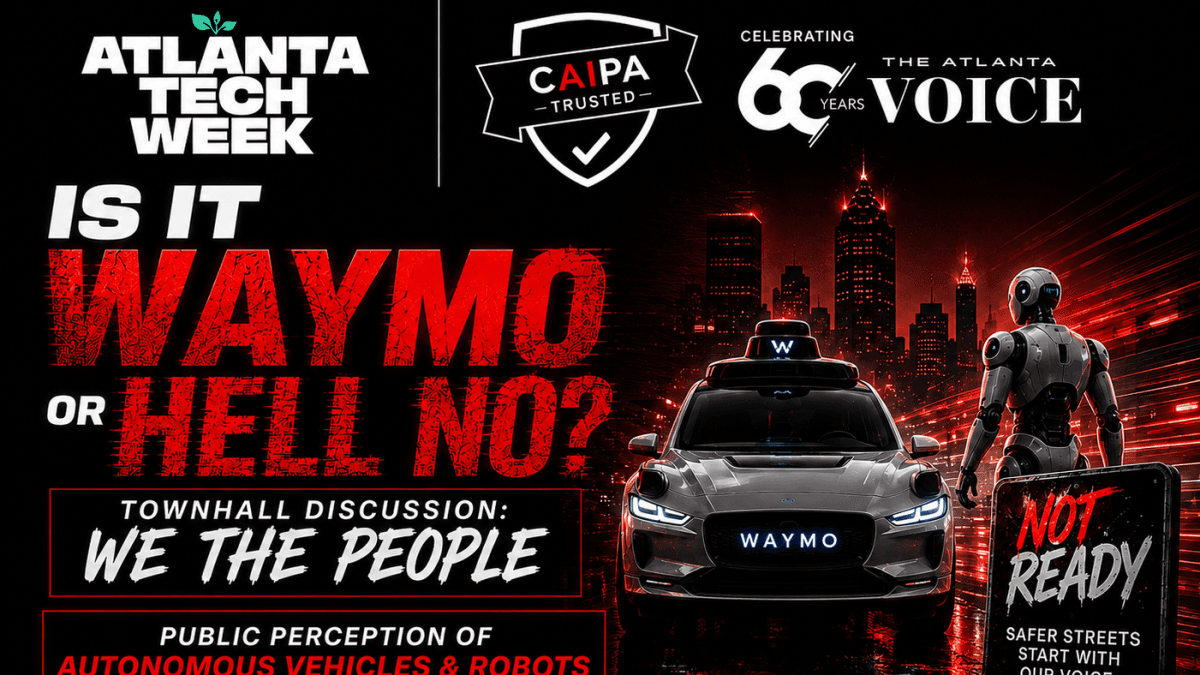
This is why the Atlanta town hall debate documentary event matters. Atlanta Tech Week offers the right stage for a serious, public-facing conversation about what autonomous mobility should look like before the industry becomes even more normalized. A town hall format forces the debate into the open: engineers, policymakers, residents, advocates, and skeptics all in the same room, asking the same central question — how do we make sure innovation serves the public?
If this becomes a Netflix documentary conversation, the stakes get even larger. The story is no longer just about one company or one city. It becomes a national conversation about trust, regulation, neighborhood impact, and the future of automated mobility in America.
The bottom line
Autonomous cars may be safer than human drivers in some measurable ways, but safety is not only a spreadsheet. It is also whether the public feels protected, respected, and heard.
That is why this debate is just beginning. The real test for autonomous vehicles is not whether they can drive themselves — it is whether they can earn the right to operate in the communities they depend on.nbclosangeles+2